
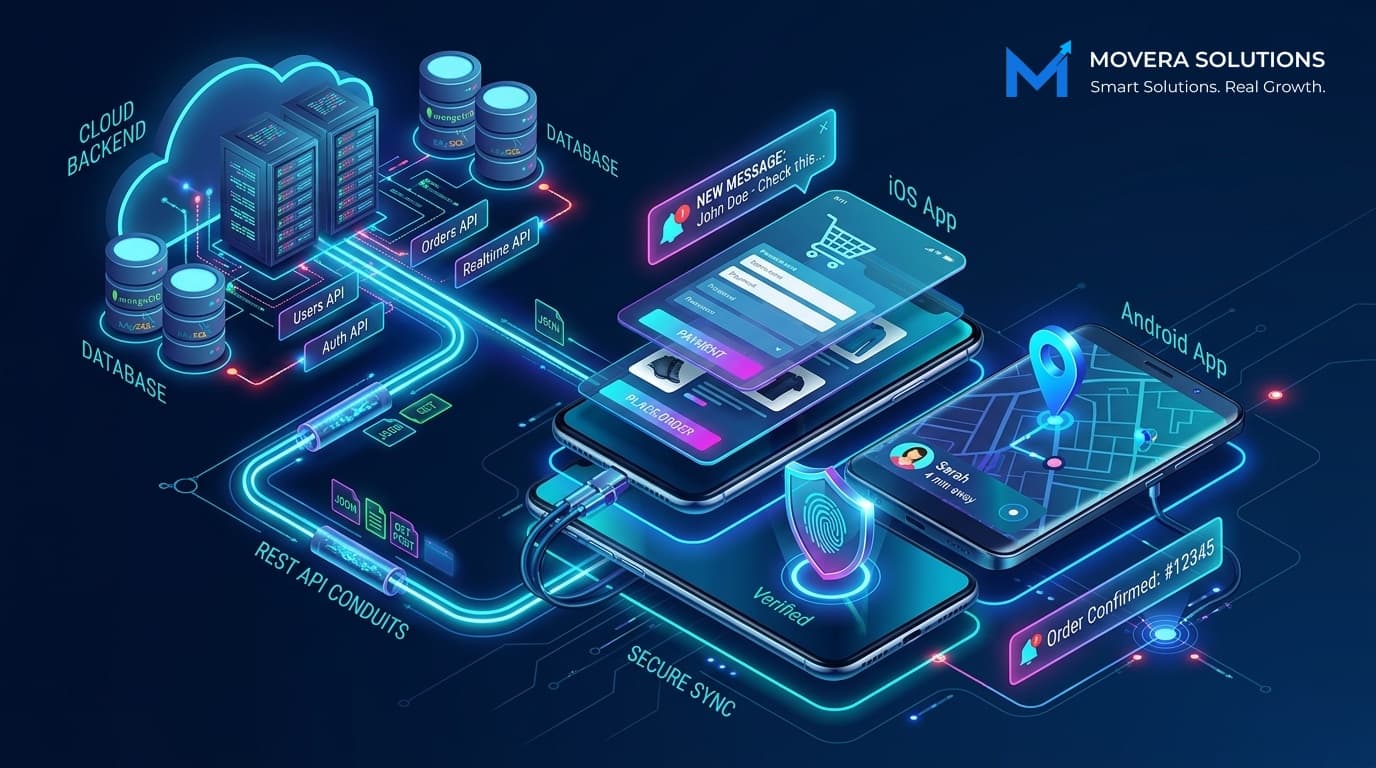
In 2026, modern cross-platform engineering frameworks—led by Flutter and React Native—are the recommended architectural choice for over 85% of commercial B2B, e-commerce, and on-demand mobile applications. They reduce development and maintenance expenditures by up to 45% and accelerate time-to-market by 2x via a unified codebase delivering fluid 60fps performance across iOS and Android. Pure Native development (Swift & Kotlin) is primarily reserved for compute-intensive 3D gaming, complex augmented reality (AR), or specialized cryptographic banking utilities.
The Dual-Team Overhead Trap: Do You Really Need Separate Teams for iOS & Android?
When expanding digital operations across Saudi Arabia, the UAE, or Egypt, commercial leaders encounter a fundamental trade-off: hiring separate Swift (iOS) and Kotlin (Android) engineering units doubles development payroll, duplicates QA test cycles, and inevitably leads to feature discrepancies between platforms.
At Movera Solutions Mobile App Engineering, we evaluate technological feasibility with commercial pragmatism. By selecting the optimal framework aligned with your feature requirements, we construct robust, responsive mobile applications that meet stringent Apple App Store and Google Play guidelines while optimizing capital efficiency.
A single unified codebase drastically curtails engineering hours and feature parity drift.
Next-gen rendering engines (Impeller on Flutter & Fabric on React Native) ensure zero UI stutter.
Rigorous automated pre-flight testing prevents Apple App Review and Google Play policy rejections.
Comprehensive Framework Evaluation: Flutter vs. React Native vs. Native
The following architectural breakdown highlights the practical trade-offs between contemporary mobile development stacks:
| Strategic Metric | Flutter (Google Dart) | React Native (Meta JS/TS) | Pure Native (Swift & Kotlin) |
|---|---|---|---|
| UI Rendering Engine | Own hardware-accelerated graphics engine (Impeller); 100% pixel-perfect uniformity | Native host OS bridge (Fabric); renders authentic native OS controls | Direct OS platform UI kits (SwiftUI & Jetpack Compose) |
| Time-to-Market & Cost | Fastest; single codebase covers iOS, Android, and web with high component reusability | Fast; high code sharing between React web applications and mobile apps | Slowest & costliest; requires 2 distinct codebases and specialized developers |
| Hardware Integration (Sensors, BLE) | Comprehensive via official pub.dev plugins (Biometrics, Camera, Geolocation) | Extensive npm ecosystem with native module bridge fallbacks | Zero latency; day-one access to beta APIs released by Apple and Google |
| Optimal Use Cases | Retail, delivery logistics, on-demand marketplaces, and SaaS mobile extensions | Social platforms, content portals, and businesses already running React web apps | 3D engines, augmented reality, and enterprise security crypto-hardware tools |
The 4 Architectural Pillars of Scalable Mobile Products
Successful mobile software requires an end-to-end disciplined lifecycle from concept to app store ranking:
1. Mobile-First Ergonomic UI/UX Design
Crafting thumb-friendly navigation wireframes, interactive micro-interactions, and frictionless onboarding through Bespoke UI/UX Engineering.
2. Regional Payment Gateways & One-Tap Checkout
Native SDK integration with trusted regional payment solutions: Apple Pay, mada, STC Pay, Tamara, Tabby, and Stripe, fully tokenized to ensure maximum checkout conversion and data compliance.
3. High-Throughput RESTful APIs & Offline Sync
Building encrypted RESTful API Endpoints connected to backend databases and Movera ERP with local SQLite caching for seamless offline usability.
4. Store Release Management & ASO Compliance
Managing Developer Console setup on Apple Developer and Google Play, preparing localized App Store Optimization (ASO) screenshots, privacy policy documentation, and handling approvals through to public availability.
Have a Mobile App Concept and Looking for an Experienced Engineering Team?
Consult with Movera Solutions mobile architects. We will evaluate your functional specs, recommend the best-fit technology stack, and provide an initial architectural blueprint and transparent milestone estimate free of charge.
Frequently Asked Questions About Mobile App Development
What is the typical timeframe required to build and publish a mobile app?
Most enterprise mobile applications take between 4 to 10 weeks depending on feature complexity and external API integrations. This timeframe includes requirements discovery, UI/UX prototyping, front-end and backend engineering, automated stress testing, and store review cycles.
Will our company own 100% of the mobile application source code?
Yes. Movera Solutions transfers complete, unencumbered Intellectual Property (IP) and source code ownership upon project completion. Your code is thoroughly documented, modular, and version-controlled on your proprietary Git repositories.
Do you provide ongoing support, bug fixes, and OS compatibility updates?
Yes. We provide continuous maintenance SLAs through our Technical Support & Maintenance Service, covering server monitoring, instant hotfixes, and annual compatibility updates for new iOS and Android releases.

Movera Solutions Mobile Engineering Team
Verified AuthorThe Movera Solutions engineering and consulting team brings deep expertise in Enterprise Resource Planning (ERP), scalable cloud architecture, and digital transformation. We help enterprises across Saudi Arabia, UAE, and the MENA region automate workflows with peak operational efficiency and optimized TCO.